Sealing and Decommissioning Unused Wells
An unused well is an open path from the surface straight into the aquifer that supplies the surrounding properties. New Jersey regulates how wells are sealed, and capping one or filling it with dirt does not meet that standard.
Call (908) 454-8008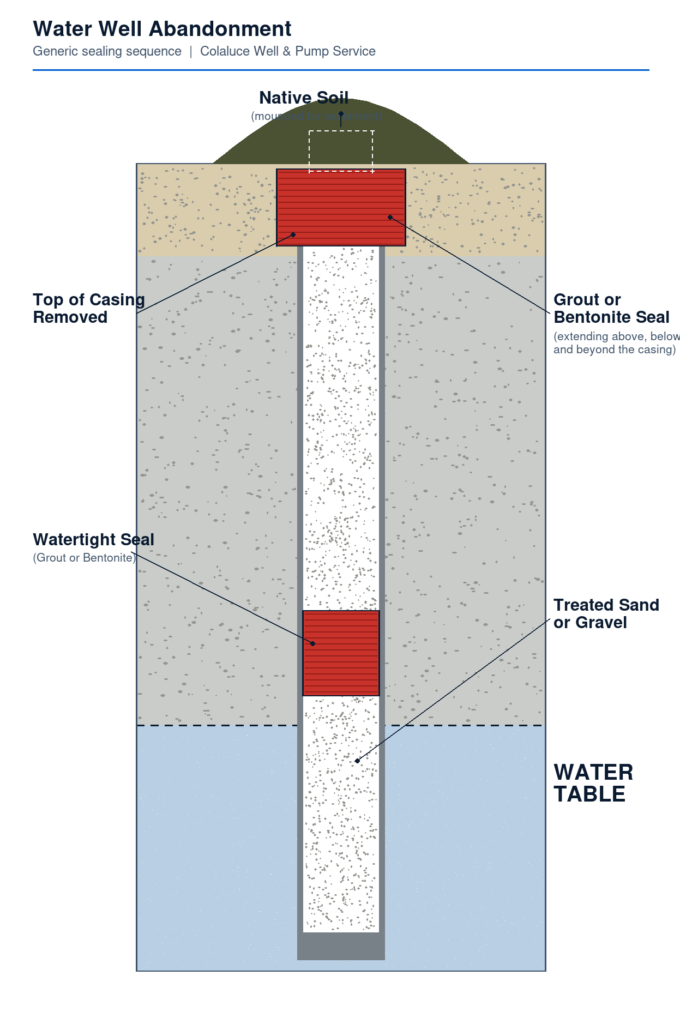
Illustrative only. Not to scale, and not for construction or regulatory submission. Requirements vary by well type and current NJDEP rules.
What proper sealing actually looks like
A well is not sealed by capping it or pushing soil down the hole. The borehole has to be filled in a controlled sequence so no open path is left between the surface and the aquifer, and so nothing settles out later and reopens one.
Everything comes out first. Pump, drop pipe, wiring, and any obstruction are removed so the hole is clear for its full depth.
The hole is backfilled with treated sand or gravel. Clean, inert material rather than whatever happens to be lying around the property.
A watertight seal of grout or bentonite goes in above the water table. This is the barrier that stops surface water travelling down the old borehole into the aquifer.
The top of the casing is removed and a second seal placed. That seal extends above, below, and beyond the casing, so there is no gap left around the outside of it.
Native soil is backfilled and mounded. Mounding allows for settlement, so the ground does not dish out later and pond water over the seal.
Exact materials, depths, and seal dimensions are set by the rules that apply to your well and your location. We confirm those before the work is scheduled.
When a well needs to be sealed
A replacement well was drilled
The old well stays a contamination path until it is properly sealed, even if nothing is connected to it.
Property development or subdivision
Often required before construction or before a lot can be approved.
The well is contaminated or collapsed
Sealing prevents the problem from reaching the aquifer other wells draw from.
How the hole is closed
Obstructions are removed, the borehole is backfilled with treated sand or gravel, and watertight seals of grout or bentonite are placed so no open path is left to the aquifer.
Need an old well sealed properly?
Whether it is for a sale, an inspection, or a well you simply do not use any more, we will seal it to New Jersey standards and document it.
Monday to Friday, 9 to 5. Licensed NJ Master Well Driller MD#969.